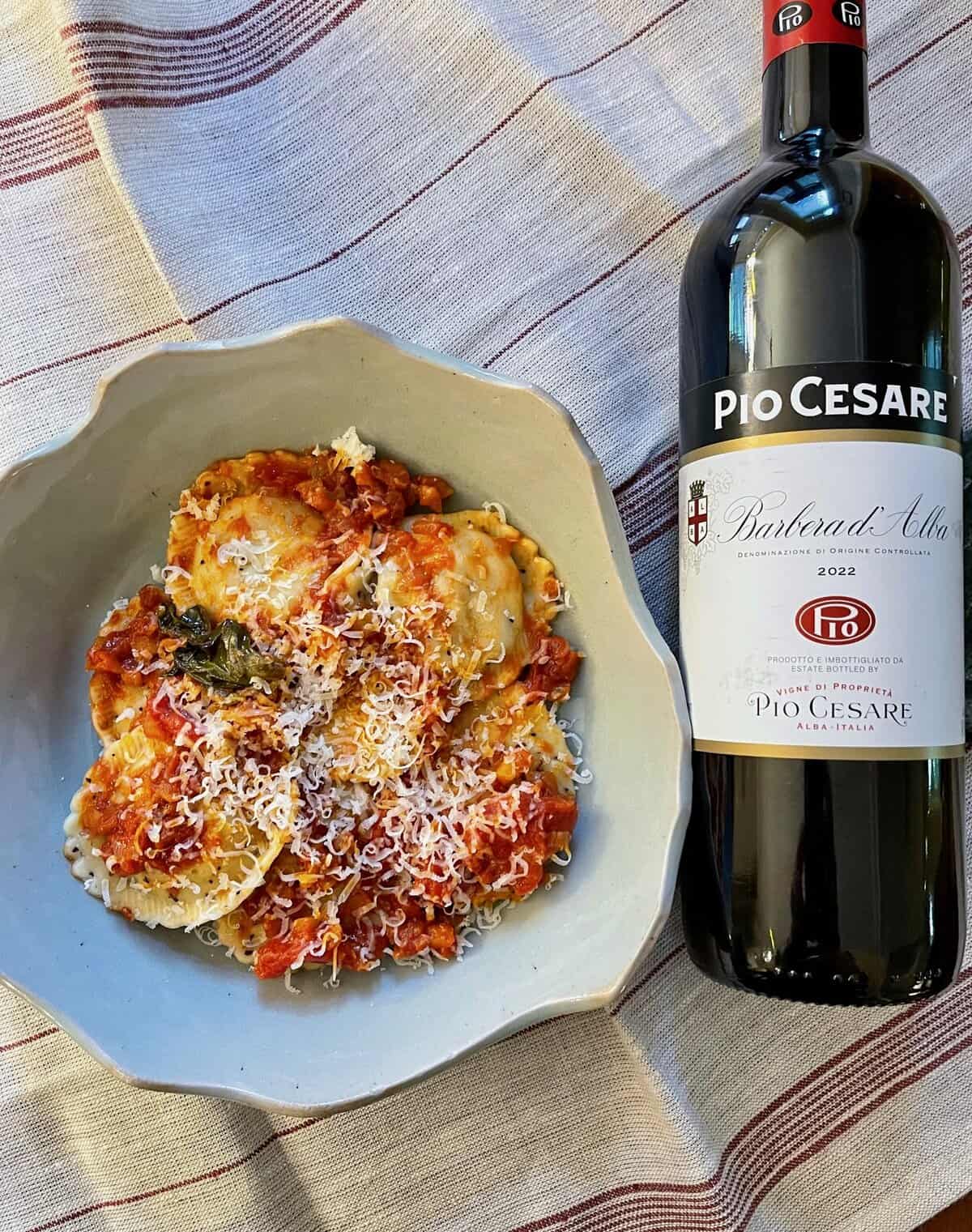
Italian Sausage Ravioli paired with Barbera d’Alba. Barbera is one of Italy’s most planted grape varieties, with most plantings in Piemonte. The Barbera d’Alba DOC includes the town of Alba and extends on both sides of the Tanaro River and the surrounding Langhe hills. Agnolotti del Plin is a local specialty, fresh pasta filled with roasted meats. I took a variation and paired the Pio Cesare Barbera d’Alba with Italian Sausage Ravioli and a Sugo Finto (meatless tomato and vegetable sauce). A classic wine pairing, what grows together goes together.
Barbera (bar-bare-ah)
Where Does it Grow in Italy
Barbera is grown throughout Italy, specifically Northern Italy in Piemonte. The epicenter of production is in the Monferrato Hills. Barbera d’Asti DOCG covers a large area of the Monferrato region, with Asti in the center of the appellation. The vineyards here are required to be planted on the hillsides below 2000 feet in elevation. The soils north of Asti are calcareous marls and sand known as Sabbie Astiane (Asti sands), and to the south, sandstones and compact calcareous marls known as Terre Bianche.
Barbera d’Alba DOC in the Langhe Hills around Alba is another noteworthy area of Barbera production. The appellation covers both sides of the Tanaro River. On the right bank, the production zone is almost identical to that of Barolo and Barbaresco. On the left bank, the appellation includes the hills of Roero. Vineyards are planted on the hillsides; the soils are layers of calcareous marls, sandstone, and sand.
Barbera Styles and Aroma and Flavor Profile
Barbera styles range from easy drinking, everyday bright, fresh, and juicy wines to richer, complex, structured, and oak-aged versions. The variety is known for high acidity and low tannins. Aromas and flavors in Barbera may include: cherry, plum, raspberry, violet, spices, herbs, and vanilla.
In general, Barbera d’Alba tends to be richer and fuller-bodied than styles from Barbera d’Asti.
Food Pairings with Barbera
Barbera food pairings: the local specialty “Agnolotti del Plin (pasta filled with roasted meats served with parmesan, nutmeg, and gravy, grilled and roasted chicken, sausages, and lamb, pasta bolognese, pasta filled with pumpkin and sage, braises with red meat and game, mushroom risotto, and pizza. In general, tomatoes and tomato sauces, sauces made with Madeira or Marsala, and herbs like sage, rosemary, nutmeg, and mace.
Pio Cesare
Pio Cesare was established in 1881 in the center of Alba. The winery is built on the ruins of Roman walls that are over 2000 years old. The estate owns and sustainably farms just over 170 acres of vineyards in Barolo, Barbaresco, and Colli Tortonesi – no chemicals are used on the vines. Federica Boffa is the fifth generation of the family and currently leads the continuing family style of Pio Cesare wines.
My Wine Tasting Notes
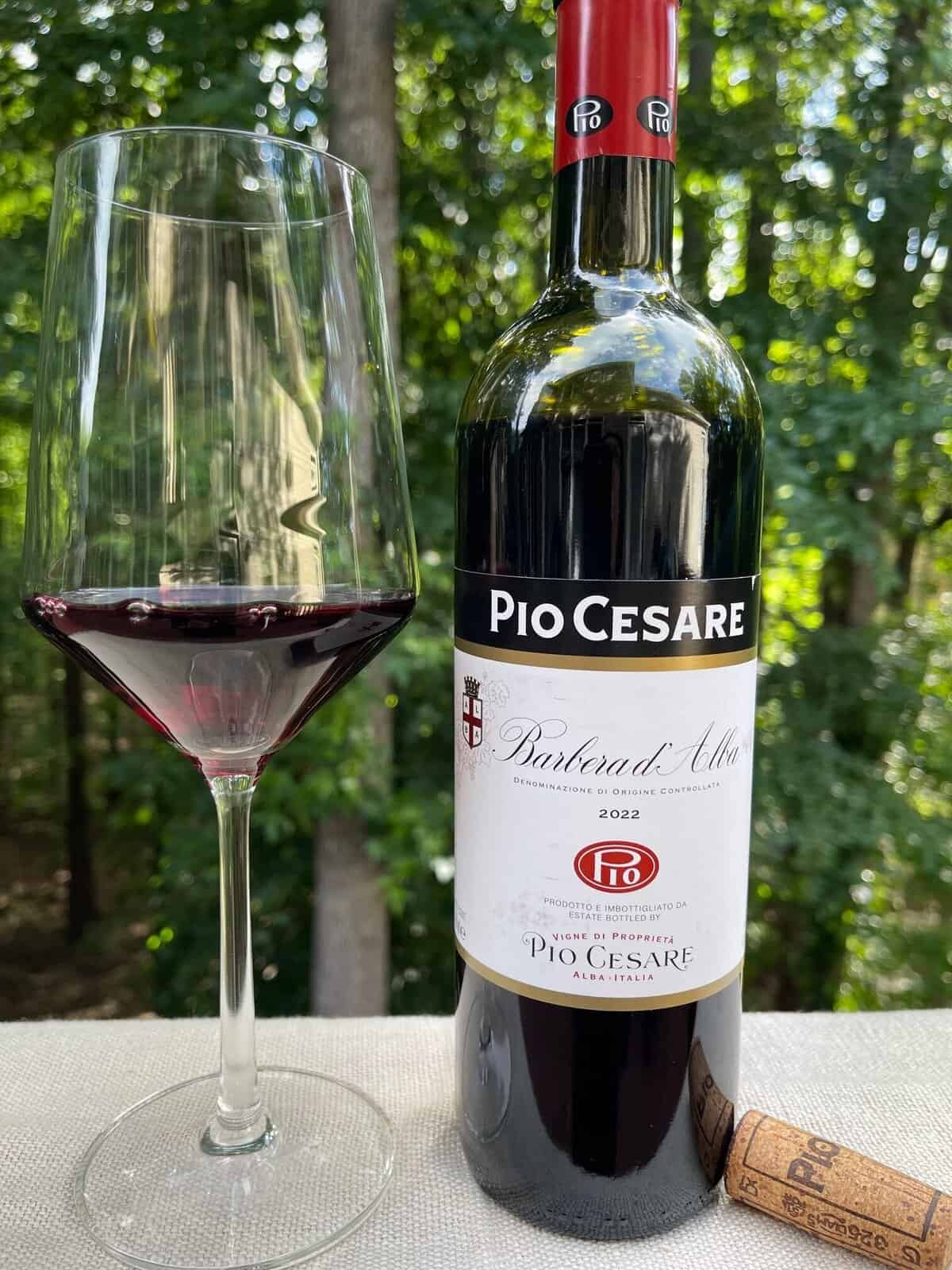
2022 Pio Cesare Barbera d’Alba DOC, Piemonte, Italy
14.5% ABV | $30.00 | 100% Barbera
Bright medium ruby in color with aromas of spice, raspberry, plum, and blackberry. On the palate, medium(+) bodied, medium tannins, and medium(+) acidity. Notes of cherries, plum, spice, raspberry, blackberry with hints of licorice and toasted tobacco on the finish. The wine is well balance with good structure.
The grapes for the wine came from family-owned vineyards in Serraluga d’Alba, Sinio, Diano d’Alba, and Grinzane Cavour. The grape must spent 15 days of skin contact in stainless steel temperature controlled fermenters. The wine was aged for 18 months in french Allier oak, 30% in mid-toasted barriques that are half new and half one year old, the remaining 70% was aged in 20 to 50 hectoliter casks of Allier oak that are about 8 years old.
My Food Pairing Notes
I paired the Pio Cesare Barbera d’Alba with Italian Sausage Ravioli and a Sugo Finto (meatless tomato and vegetable sauce) — a variation of the local specialty Agnolotti de Plin. The Italian Sausage Raviolis were perfect with the wine’s fruit flavors, high acidity, and smooth tannins. The acidity of the tomato sauce matched the wine’s acidity. Indeed, food and wine that evolve in a region often pair well at the table.
* The Italian Sausage Ravioli was purchased from a local pasta shop Pasta Mami and the Sugo Finto recipe is from Divina Cucina’s Recipes by Judy Witts Francini
Fantastic book you used as a food source
I agree! I do love my wine books.
Ahh Jane, I am going to convince John to move to your neighborhood so I can beg for a seat at your table lol!
Yes, please!!!!!